The short answer
Low-e glass has a coating built into the glazing system, while solar-control film is applied to existing glass. Their effects depend on the specific products and glass construction. Identify your windows before adding film, then compare solar heat gain, visible light, compatibility and written warranty coverage for the proposed combination.
What low-e glass is
Low-emissivity (low-e) glass carries a "microscopically thin transparent coating" of metal or metallic oxide that reduces thermal infrared emittance by reflecting heat (ACEEE). A Department of Energy presentation describes the coating as roughly 1/100th the thickness of a human hair, acting as a "heat mirror" (U.S. DOE).
DOE's building-science program explains that high-performance windows typically combine two or three panes, insulating spacers, gas fills such as argon or krypton, and low-e coatings that block radiant energy while allowing visible light through. That combination helps prevent overheating and protects furnishings and floors from fading (Building Science Education, DOE).
Not all low-e is the same. Some coatings are designed to keep winter heat in while admitting solar gain (higher SHGC, useful in cold climates). Others, often called low-solar-gain or spectrally selective low-e, block much more solar heat for cooling climates. The coating's position in the unit (which glass surface) also changes performance.
What solar-control film is
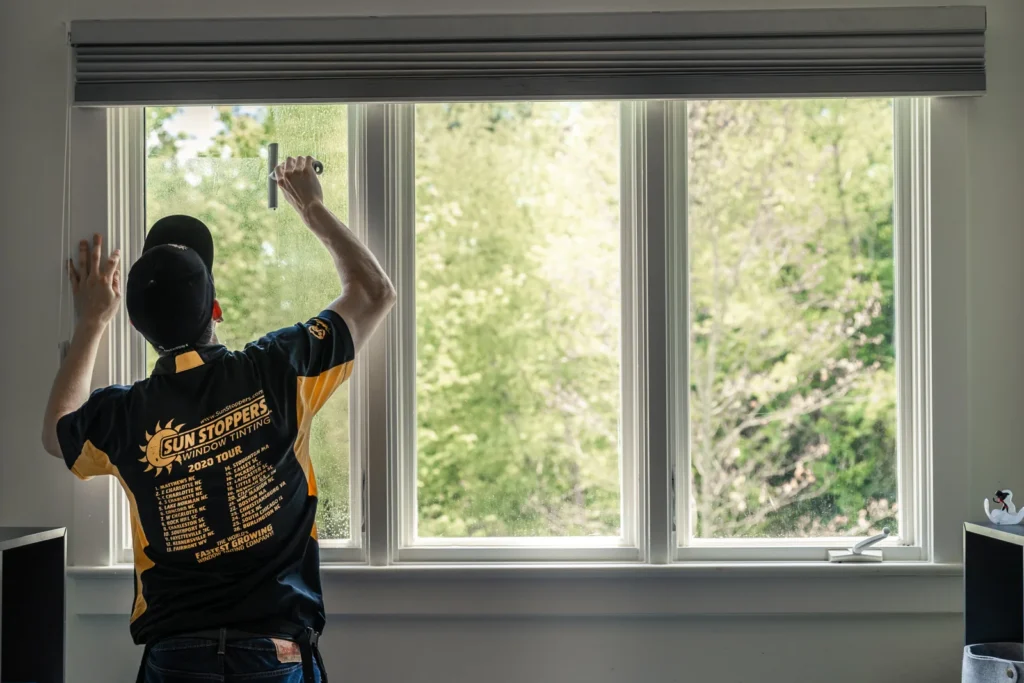
Window film is a retrofit product, generally polyester, usually applied to the inside surface of the glass with a scratch-resistant top coat (Whole Building Design Guide). Types include dyed, metallized/reflective, ceramic, multilayer non-metallized, and low-e films.
Low-e films add a low-emissivity layer to the room side of the glass, so they also reduce radiant heat loss in winter. The U.S. General Services Administration reports Lawrence Berkeley National Laboratory testing that found low-e window film produced 29 percent average perimeter HVAC savings compared with single-pane clear glass (GSA). Berkeley Lab has also studied low-e applied films as a retrofit for both insulation and solar control (Berkeley Lab).
Side-by-side
| Factory low-e glass | Solar-control film | Low-e film | |
|---|---|---|---|
| When it's added | At manufacture | Retrofit | Retrofit |
| Main effect | Reduces radiant heat transfer; SHGC depends on coating | Reduces solar heat gain, glare, UV | Reduces solar gain and some winter heat loss |
| Effect on U-factor | Significant (in combination with insulating glass) | Minimal | Moderate improvement |
| Adjustable | No | No | No |
| Durability | Life of the window | Varies; warranties up to lifetime for owner | Varies |
| Cost | Part of window purchase | A fraction of replacement | Usually more than standard solar film |
Sample data on single-pane clear glass from a LLumar specification sheet: clear glass alone has an SHGC of 0.86; a residential low-e film drops it to 0.25 with 26 percent visible light transmission (LLumar/Eastman). Results on double-pane or low-e glass will be different.
Should you put film on low-e windows?
Sometimes. It depends on what your low-e coating already does and what problem you're trying to solve.
The International Window Film Association says whether film should be used on low-e windows depends on the type of low-e surface, where it's located in the window, and the heat-gain reduction or other benefits you want, and advises asking your dealer whether your low-e windows can be filmed (IWFA).
Film can make sense when:
- Your low-e is a high-solar-gain type and specific rooms overheat in summer.
- Glare, privacy or UV is the issue rather than heat.
- You need safety or security performance.
- East- or west-facing rooms remain uncomfortable despite low-e.
Film adds less when:
- Your windows already have low-solar-gain low-e (SHGC around 0.25 or lower). ACEEE notes attachment savings are highest on single-pane or clear double-pane glass rather than low-e (ACEEE).
- The problem is drafts or condensation.
Check before installing: thermal stress risk on insulating units and the effect on your window manufacturer's seal warranty. See Can Window Film Damage Double-Pane Glass?
How to tell if you have low-e
- Look for etching or labels in a corner of the glass, or check the original window paperwork or NFRC label for SHGC and U-factor.
- Try the reflection test: hold a lighter flame or penlight near the glass in a dim room. You'll see a reflection from each glass surface; a reflection with a slightly different color tint often indicates a coated surface. This is a rough indicator only.
- Ask an installer to use a low-e detector meter. Many professionals carry one.
Climate matters for both
In heating-dominated climates, solar gain through south windows is useful in winter, and a low-SHGC film or coating can reduce it (National Trust for Historic Preservation). In cooling-dominated climates, low SHGC usually wins. Lawrence Berkeley National Laboratory's analysis for ENERGY STAR found that in northern zones a higher SHGC can produce significantly larger savings, with each 0.01 change in U-factor roughly equivalent to 0.05 of SHGC in its northern example (LBNL for ENERGY STAR).
Questions to ask
- Do my windows have low-e, and what is the current SHGC and U-factor?
- What will this film change about those numbers on my specific glass?
- Is this film approved for my glass type and low-e surface?
- How does it affect my window manufacturer's warranty?
- In my climate, what does this do to winter heating?
Sources
- ACEEE: Residential window attachments
- U.S. DOE Better Buildings Residential Network: Window treatments (2019)
- Building Science Education (DOE): High-performance window systems
- Whole Building Design Guide: Window film fundamentals
- U.S. General Services Administration: Low-e window film
- Berkeley Lab: Low-e applied film window retrofit (2017)
- LLumar (Eastman): Architectural solar film specifications
- International Window Film Association: FAQ
- National Trust for Historic Preservation: Saving Windows, Saving Money (2012)
- LBNL for ENERGY STAR: Windows energy savings analysis (2012)
Want this answered for your own windows?
Planning a home or office project in the Charlotte area of North Carolina or South Carolina? Request a project-specific quote and include your installation ZIP code. Availability is confirmed for your address.
Related guides
- Can Window Film Reduce Air Conditioning Costs?
- How Much Does Residential Window Tinting Cost?
- Window Film vs. Replacement Windows
Planning a project in the Charlotte area? Explore Sun Stoppers home window tinting services. For workplace glare or glass privacy, see commercial window tinting in Charlotte.
Still comparing options? Ask a question about your windows. For approximate coverage within 40 miles of Uptown Charlotte, check the service-area ZIP list.
Updated October 20, 2026. Educational guidance from Tint My Home Windows, powered by Sun Stoppers. Film selection, glass compatibility and warranty terms require project-specific confirmation.