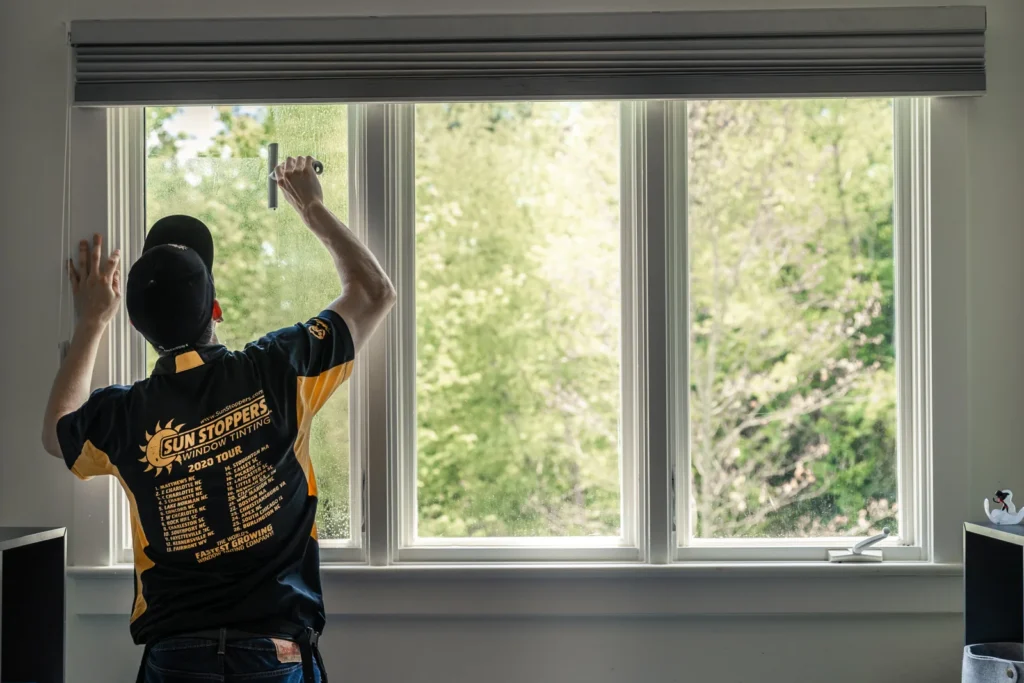
The short answer
Choose an installer who identifies your glass, explains suitable film options and provides an itemized proposal with written warranty terms. Ask about manufacturer authorization, relevant residential experience, preparation, aftercare and compatibility checks. A useful recommendation should explain tradeoffs and situations where shades, repairs or another solution may be more appropriate.
What a good installer does differently
- Asks about the problem first. Heat, glare, fading, privacy or safety each lead to different products.
- Looks at the glass. Single or double pane, low-e, tempered or annealed, size, condition of edges, shading on the glass.
- Checks compatibility against the manufacturer's film-to-glass guidelines (IWFA).
- Shows samples on your windows.
- Explains trade-offs, including when shades, exterior shading or other fixes may work better.
- Puts everything in writing.
Credentials worth checking
Manufacturer authorization. Most major film brands work through authorized dealers, and warranties typically require installation by an authorized or professional installer (Avery Dennison; 3M). Ask which brands they're authorized for and confirm on the manufacturer's dealer locator.
IWFA accreditation. The International Window Film Association offers accreditation exams for solar control and other specialties. Accreditation is granted to individuals, not companies, and requires passing an exam with at least 80 percent correct answers (IWFA). Ask who on the crew holds it.
License and insurance. The Federal Trade Commission advises hiring only licensed and insured contractors, confirming licenses with state or county agencies, and asking for proof of insurance (FTC). Licensing requirements for window film vary by state and locality; ask what applies where you live, and request a certificate of liability insurance.
Experience with your type of home. Large insulated glass, skylights, historic sash or multi-story exteriors each need specific experience. Ask for examples of similar jobs.
Reviews and references
The FTC recommends getting recommendations from people you trust, checking with local consumer protection officials for complaints, and searching the company name with words like "complaint" or "review" (FTC). Look for patterns in reviews, especially how the company handled problems.
What a good proposal includes
| Item | Why it matters |
|---|---|
| Film brand, product line and shade | "Ceramic 35" can mean many different products |
| Performance on your glass: VLT, SHGC, UV rejection, reflectance | So you know what you're getting |
| Windows included, with square footage | Enables fair comparison |
| Glass type observed, compatibility confirmed | Reduces thermal stress and warranty risk |
| Prep work, including old film removal | A common hidden cost |
| Manufacturer warranty and installer workmanship warranty | Two different promises |
| Start date, duration, cure time and care instructions | Sets expectations |
| Price, payment schedule and cancellation terms | Protects you |
The FTC recommends getting multiple written estimates, not automatically choosing the lowest bid, and asking about large differences between estimates (FTC). It also notes that contracts signed at your home generally come with a written right to cancel within three business days.
Red flags
From the FTC's home-improvement guidance (FTC) and common sense for this category:
- Door-to-door offers claiming they're "in the area" with leftover material
- Pressure to decide immediately or "today-only" pricing
- Requests for full payment up front or cash only
- Quotes that don't name the film product
- Guaranteed energy savings percentages without analysis of your home
- Claims that film will "stop" fading or "eliminate" heat
- No questions about your glass type before recommending a film
- Unwillingness to show the manufacturer's warranty
The FTC advises never making the final payment until the work is done and you're satisfied (FTC).
On installation day
- Clear sills and move furniture back a few feet.
- Expect the installer to protect floors and use drop cloths.
- Ask to see the film box or label to confirm the product.
- Expect some haze or small water pockets while film cures; 3M advises waiting at least 90 days before reporting adhesion or appearance issues and not washing filmed windows for 30 days (3M).
- Walk through the job before final payment and note edge gaps, debris or scratches.
Questions to ask on the first call
- Which film brands are you authorized to install, and does anyone on the team hold IWFA accreditation?
- Are you licensed and insured where I live? Can you send proof?
- Will you inspect my glass before recommending a film?
- Can I see samples on my own windows?
- What does your workmanship warranty cover, and for how long?
- Can you provide references from jobs like mine?
A shortcut
If you would rather not vet installers yourself, request a free quote and a window film specialist serving your area will come out, look at your glass and answer every question on this list. Whatever source you use, apply the checks above.
Sources
- International Window Film Association: Accreditation testing and FAQ
- Federal Trade Commission: How to avoid a home improvement scam (2022)
- Avery Dennison: Interior architectural window film warranty
- 3M: Sample Platinum residential warranty
- 3M: Window film warranty bulletin
Want this answered for your own windows?
Planning a home or office project in the Charlotte area of North Carolina or South Carolina? Request a project-specific quote and include your installation ZIP code. Availability is confirmed for your address.
Related guides
- Residential Window Film Warranty Questions
- Window Film for Historic Homes
- How to Read a Window Film Specification Sheet
Planning a project in the Charlotte area? Explore Sun Stoppers home window tinting services. For workplace glare or glass privacy, see commercial window tinting in Charlotte.
Still comparing options? Ask a question about your windows. For approximate coverage within 40 miles of Uptown Charlotte, check the service-area ZIP list.
Updated October 20, 2026. Educational guidance from Tint My Home Windows, powered by Sun Stoppers. Film selection, glass compatibility and warranty terms require project-specific confirmation.